ACE Model of Elite Performance

Updated: Sep 15
In 2003, Google faced a scaling crisis. It was mining data - petabytes of it - for insight. Because of the scale, the data had to be scattered across thousands of machines connected over the network. Experts in large-scale distributed systems were rare and expensive, and every batch job required one. The data grew more and more, but optimization gave less and less. It seemed the insight machine could soon stall.
Jeff Dean and Sanjay Ghemawat found a way to tackle the problem from a novel angle. They used some obscure forty-year old functional programming primitives to push the burden of parallelism onto the infrastructure - abstract the problem away from the coders' hands. This allowed the engineers to produce many different batch jobs using simple building blocks.
Instead of making every engineer solve a distributed system problem, they dissolved it. The components were classic computer science. Every senior engineer at Google heard of them. Some could have built the entire runtime. None of them saw that this abstraction, at this moment, would make the problem vanish. The industry took a while to catch up, and Google's success became stratospheric.
Stories like this make elite performance sound like lightning – rare and unpredictable. In some sense, it is, but it also has structure.
The Power of Complexity
Elite performance is a consistent delivery of outsized impact. The reason it's rare is deep.
No matter how talented you are, you can't achieve elite performance while dealing with "tame" problems. Here, solving a problem means executing a known procedure. At some point, making more effort yields just slightly better results, and if you ask many people to solve the same problem, you will find that their performance follows the normal distribution - the bell curve. Diminishing returns keep performance trapped under the hump. This is true for coffee makers, steel manufacturers, and assembly line workers. No one will pay ten times more for a 10% better coffee.
VCs, software engineers, and surgeons face a "gnarly" world. Here, no best-practice exist, every problem is a snowflake, and a 10% difference in judgement is the difference between a unicorn and a bankrupt, between MapReduce and MPI, between life and death. Will you pay 10x to be operated on by an elite neurosurgeon instead of just a competent one? Performance on gnarly problems follows the power law - the hockey stick.
The difference between the tame and gnarly problems is hidden leverage. Gnarly problems engage the performer with a complex system and the magnifying relationships between its parts, which makes it hard to predict the outcome of actions. A barista controls the coffee grind, water temperature, and pressure. A surgeon tinkers with the open internals of one of the most intricate systems in the world.
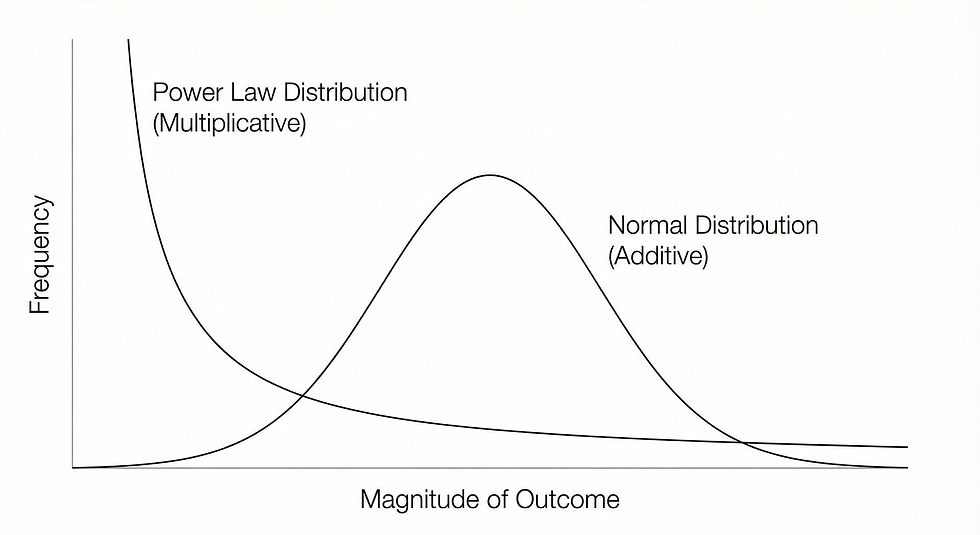
When dealing with tame problems, expect additive returns, and set consistency as a goal. Manage to a standard, and care about efficiency. With gnarly problems, slightly different decisions give very different results - expect multiplicative returns, and set leverage as a goal. Manage for a breakthrough, and care about elite performance.
Elite Performance in Tech
Almost any tech company with a serious approach to performance management uses some version of a Career Path, a matrix of behavioral expectations tied to a certain seniority level. It keeps pay fair. It raises the bar. It gives managers a convenient evaluation tool based on real-world behavioral signals. It makes an assumption, though, that software engineering deals with tame problems. Truth be told, most engineering does. But that's not the kind of engineering that decides the fates of companies.
Another issue is that while career paths excel at measuring the past, they hardly help in guiding the future. Behavioral signals arrive after the fact, and managers struggle to interpret and convert them into actions that help people improve.
How do you help an engineer with deep Python knowledge who spends six months building a technically perfect feature that no one wants? The Career Path gives you no answer.
To guide advice based on Career Path signals, most managers in tech use the Will vs. Skill personality model. It makes a useful distinction between "Can they do it?" (Skill) and "Do they want to do it?" (Will). Managers design many effective interventions based on this simple split.
But the architect, who never ships value, has High Will and High Skill, yet they fail. They lack something else.
The ACE Model
I created the ACE model specifically to find and grow elite performers among engineers and engineering leaders. It distills years of observing both successful and failed performers across business, sports, military, and craft. Take it for what it is - a field report. It is anecdotal and biased. It has no p-values. It only has a track record of a few broken plateaus, a bunch of Staff promotions, and a handful of FAANG offers.
I designed it so I could easily combine ACE with any company's Career Path to create a complete, effective performance management tool for different environments.
The model rests on three pillars: Architect, Compass, and Engine. We start with Compass, the central pillar that supports the entire structure at its most critical (should I say load-bearing?) point.
1. Compass (Taste + Sensibility)
The Mark of an Elite Performer.
Career ladders prize 'autonomous impact' but leave the navigation to the confused practitioners. They set the destination, but they never give the map. I use the ACE model as the missing guidance system. It reminds you need to have a Compass to find 'magnetic north.'
Taste: The ability to discern quality. Plato called it "knowing the form of the good" - the capacity he thought should determine who makes the decisions. Twenty-four centuries later, we still don't have a better language for it. In tech, it shows up as "product sense" or "strategic intuition."
Sensibility: The capacity to feel quality. The "magnet strength" - emotional connection to excellence and the visceral refusal to settle for mediocrity.
2. Architect (Strategy + Tactics)
The Leveraged Application of Skill.
The "Skill" bucket in traditional models is useful, but it often suggests the wrong tool for the job. In engineering, you should always separate the "gnarly", the ill-formulated and confusing problems that require "snowflake" solutions; and "tame", the definable and understood problems that have standard "LEGO-brick" solutions. You need to master both if you want to be an elite performer.
Strategy: a plan to tackle a gnarly problem. What do you do if your engineering velocity has dropped by half, production is down every week, but you cannot stop shipping features to fix the legacy spaghetti code because the business is behind its targets?
Tactics: best-practice to solve a tame problem. Implementing auth, caches, and even migrating data.
Strategies are designed, tactics are drilled.
3. Engine (Energy + Focus)
The Sustainable Drive.
ACE gives another angle at the combination of what Angela Duckworth calls this Grit, and what traditional matrices call Will.
Energy: The capacity for sustained intensity. Most treat work as a slow burn, a candle designed to last. Elite performance is more like fireworks - a series of timed explosions with silent and precise positioning between them.
Focus: The ability to direct energy at productive work and resist distraction. Energy without focus is noise; focus without energy is stagnation.
Why ACE Matters Now
Spiking in one area doesn't make you an elite performer. Elite performance emerges only when three pillars lock into place:
The Compass sets the vector.
The Architect designs the lever.
The Engine applies the force.
Remove one, and you turn to mediocrity.
As AI makes tactics and execution affordable, we are moving past the age of the reliable employee and into the age of the high-leverage designer. While most organizations rely on career ladders to manage pay and titles, elite performance needs more than a set of lagging indicators that measure what you have already done. ACE is a leading indicator – it measures your capacity to do the next big thing.
You can climb the early steps by solving the tame problems – stacking bricks and following instructions. But as you approach the "Staff" or "Principal" levels, or build your senior management career, the ladder disappears, and a free fall follows. You won't find checklists for "sensing brittle architecture."
The next post builds the Compass. Those in free fall may wish to read promptly.